
Dust rarely escapes from machinery simply because there is “no brush”. More often, it follows a particular route: through an exposed edge, beneath a guard, around a moving component or out of the opening where material enters or leaves the machine.
That changes the way dust control should be approached. Before discussing brush density, filament length or contacting strip brush manufacturers, first follow the dust. Find where it originates, observe how machine movement affects it and identify the point at which it reaches the surrounding area. Once that path is understood, a strip brush can be designed around the actual problem rather than an assumed one.
Step 1: Map the Dust Escape Path
Begin with the machine, not a brush catalogue.
Observe the equipment while it is operating under normal production conditions. Dust that appears around the outside of a machine may have travelled some distance internally before becoming visible.
Pay particular attention to:
- Open edges around guards and enclosures
- Interfaces between stationary and moving components
- Conveyor entry and exit points
- Access doors and removable panels
- Openings required for products or materials to pass through
- Irregular gaps created by the geometry of the equipment
The objective is to distinguish the dust source from the dust escape point.
For example, material may become airborne at one point on a conveyor but escape several metres further along where the belt passes through an enclosure. Installing a brush close to the dust source would not necessarily address that particular route.
A useful design question is therefore:
Where does the material cross from the controlled machine area into an area where it should not be?
That point deserves attention first.
Step 2: Understand the Dust Before Choosing the Brush
Not everything described as “dust” behaves in the same way.
Fine, lightweight material may respond strongly to air movement around a machine. Larger particles may fall under gravity and collect around lower openings. Dry powder can behave differently from fibrous or granular residue.
Before specifying the brush, record what is actually escaping.
Fine dust
Fine particles may pass through small openings and can be influenced by air generated by moving belts, rollers, fans or nearby equipment.
Larger particles
Coarser debris may require a configuration capable of restricting the opening while allowing the intended machine movement to continue.
Dry material
Dry dust can spread beyond the immediate source, making the escape route less obvious during an initial inspection.
Airflow-influenced material
Where air movement is carrying dust, simply placing a dense brush over an opening may not address the complete cause. Airflow and pressure conditions around the opening also need to be considered.
A strip brush should therefore be treated as one component within the dust-control arrangement, rather than automatically being treated as a filtration system.
Step 3: Decide What the Brush Needs to Do
Once the escape route is known, define the brush’s job.
That sounds simple, but different objectives can produce very different specifications.
Does the brush need to:
Block: reduce an unnecessary open space through which material escapes?
Guide: influence the direction in which loose material moves?
Contain: help keep displaced particles within a particular machine area?
Wipe: make controlled contact with a moving surface to remove loose material?
Reduce an open gap: create a flexible barrier where a rigid guard cannot be used because products or machine components need to move through the opening?
The answer affects filament stiffness, trim length, density, mounting position and the amount of contact required.
This is also useful information to provide when discussing an application with strip brush manufacturers. “We need a 50 mm strip brush” gives relatively little design information. “We need to reduce dust escaping around a moving conveyor while allowing irregular products to pass” describes the engineering problem much more clearly.
Step 4: Position the Brush Around Movement
A strip brush positioned correctly while a machine is stationary may behave differently once production starts.
Belts travel. Components rotate. Products vary in height. Doors open. Panels vibrate. Material changes direction.
The brush position therefore needs to be considered in relation to movement.
A simple way to visualise the design is:
- Dust source
- Machine/material movement
- Escape point
- Strip brush position
- Material contained or redirected
Suppose dust follows a conveyor towards an opening in an enclosure. The relevant design point may be the interface between the moving belt or product and the stationary enclosure, rather than somewhere upstream.
The brush can then be positioned to reduce the exposed space while maintaining the clearance and flexibility required by the process.
The critical point is that dust control should not interfere unnecessarily with normal machine operation.
Step 5: Select Filament Characteristics Around the Application
Only after the previous steps should filament specification begin.
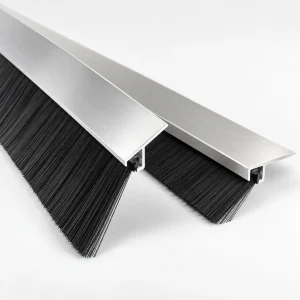
We list several standard fill options for its strip brushes, including nylon filaments, natural fibre, hair, brass wire, stainless steel and mild steel. Its strip-brush data also includes galvanised steel, stainless steel and aluminium profile options.
Four characteristics deserve particular consideration.
Material
Filament material should suit the surface, operating environment and type of contact required. Material selection may also need to account for moisture, chemicals, temperature and the sensitivity of surrounding components.
Flexibility and stiffness
A flexible filament can conform around changing shapes or moving components. A stiffer configuration can provide greater resistance, but excessive stiffness may interfere with movement or create unnecessary contact.
Trim length
Longer exposed filaments generally have more room to flex. Shorter trim can produce firmer behaviour. The appropriate length depends on the gap and required action rather than a universal dimension.
Density
More filament is not automatically better.
Density should be sufficient for the required containment or contact while still allowing the brush to respond appropriately to the moving surface or product.
Step 6: Avoid Over-Compressing the Brush
One of the easiest design mistakes is assuming that greater contact automatically means better dust control.
It does not.
When filaments are excessively compressed against a moving belt, panel or component, they have less freedom to flex. This can increase friction and accelerate wear while placing unnecessary resistance on the moving interface.
At the other extreme, insufficient contact can leave a clear escape path.
The target is controlled engagement, not maximum pressure.
During initial setup, observe the filament behaviour while the equipment is moving. The brush should perform its intended blocking, guiding, containing or wiping function without being unnecessarily crushed against the surface.
Step 7: Make Maintenance Part of the Original Design
A dust-control brush may work well when newly installed yet become ineffective if nobody can inspect or replace it easily.
Maintenance access therefore belongs on the drawing board.
Consider:
- Can operators see the working edge of the brush?
- Can accumulated material be removed without dismantling major machine sections?
- Can the strip be replaced independently?
- Is there enough access to inspect filament wear?
- Could build-up around the holder affect brush movement?
- Will worn filaments eventually reopen the original dust escape path?
Accessibility becomes particularly important on equipment where brushes are installed behind guarding or around confined conveyor interfaces.
Designing for replacement from the beginning can make maintaining the original dust-control arrangement considerably easier.
Common Dust-Control Design Mistakes
| Instead of | Ask |
| Selecting the densest brush | What material actually needs containing? |
| Covering every opening | Where is dust actually escaping? |
| Maximising contact | How much contact does the application require? |
| Choosing filament before studying movement | How will the brush interact with the moving component? |
| Copying another machine | Are its material, speed, gap and operating conditions actually comparable? |
| Treating replacement as an afterthought | How will the brush be inspected and changed? |
These questions move the specification away from guesswork and towards the actual operating conditions.
Design the Brush Around the Dust Path, Not the Other Way Around
Effective dust control begins with understanding the route that unwanted material follows.
Map the escape path. Identify the material. Define whether the brush must block, guide, contain, wipe or reduce an opening. Then consider machine movement, filament characteristics, contact and maintenance access.
The result may be a relatively simple strip brush, but its specification has been developed from the application rather than selected in isolation.
At Ganesh Brush Manufacturers, we manufacture strip brush configurations for different industrial requirements, including standard and customised brush solutions. Our available strip-brush specifications include different fill and profile materials, with customised brushes also developed around requirements such as filament stiffness, length and trim.
Frequently Asked Questions
1. Where should a strip brush be positioned for machinery dust control?
Position should be determined by the actual dust escape path. Common locations can include enclosure openings, conveyor entry or exit points, access interfaces and gaps between moving and stationary components. The brush should restrict the relevant route without unnecessarily interfering with machine operation.
2. Should a dust-control strip brush touch the moving surface?
Not necessarily. Some applications require controlled contact, while others may only require the brush to reduce an open gap. Where contact is required, excessive compression should be avoided.
3. Is a denser strip brush always better for controlling dust?
No. Density needs to suit the material and required function. Excessive density can increase resistance or prevent the filaments from responding appropriately to moving or irregular surfaces.
4. Which filament material should be used for a dust-control strip brush?
There is no single material suitable for every application. Selection depends on factors such as the material being controlled, surface contact, flexibility requirements, operating environment, moisture and temperature. Ganesh Brush’s strip-brush specifications include nylon, natural fibre, hair and several metal-wire options.
5. Can strip brushes be used around conveyor openings?
Yes, strip brushes can be considered where conveyors or conveyed products pass through an opening and a flexible barrier is required. The brush configuration should account for belt or product movement, the size of the opening and the material being contained.
6. What information should be provided for a custom machinery strip brush?
Useful information includes opening dimensions, brush length, available mounting space, type of dust or debris, moving component or product, required brush function, operating conditions and any restrictions on contact. Providing photographs or machine drawings may also help communicate the application clearly.