

Nobody puts “brush quality” on their machine downtime report. They write conveyor jam, surface defect, deburring inconsistency, or excessive cleaning time. But trace those problems back far enough and a surprising number of them end at the same place: the wrong brush running on the right machine.
Most plant managers in India have worked with at least two or three Industrial brush manufacturers in India over the years. The difference between a good one and a bad one rarely shows up in the product specification. It shows up in how the machine runs six months after installation.
This is about that gap.
The Machine Efficiency Problem Nobody Talks About
When a machine underperforms, the investigation usually looks at the motor, the drive belt, the alignment, the operator. The brush, if it is part of the assembly, gets checked last. Or not at all.
This is understandable. Brushes are consumables. They are expected to wear out. The assumption is that one brush is more or less the same as another, as long as it fits the mounting and looks about right.
That assumption is expensive.
A brush that is slightly too stiff for the application puts unnecessary load on the motor. A brush with uneven filament density creates inconsistent contact pressure, which shows up as patchy cleaning or uneven finishing. A brush running past its useful life does not just perform poorly. It can actively damage the surface or component it is supposed to treat.
None of these are dramatic failures. They are slow drains on machine performance, running continuously, while your team is busy with more visible problems.
What the Right Brush Actually Does for a Machine
The right brush does not just complete a task. It completes it without generating secondary problems down the line.
Here is what that looks like in practice across common industrial applications:
Conveyor cleaning and debris removal A brush with the correct filament stiffness and trim length clears debris cleanly in a single pass. A brush that is too soft leaves residue. One that is too stiff lifts product off the belt. Getting the specification right means the conveyor runs at full speed without stopping for manual cleaning between shifts.
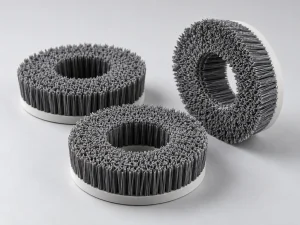
Surface finishing and deburring In metal fabrication, the brush is doing precision work even if it does not look like it. An Abrasive nylon brush on a deburring line needs consistent filament contact across the full working width. If the filament density varies across batches, the finish varies. That creates rework. Rework creates cost.
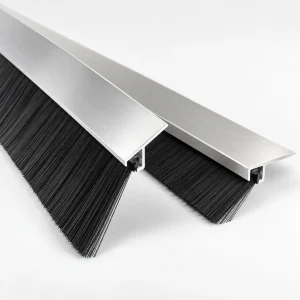
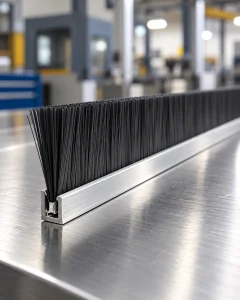
Sealing and dust control Strip brushes used for gap sealing in machinery need enough resistance to block airflow and particulates without creating drag that the drive system has to fight against. Too little filament density and the seal leaks. Too much and you are adding friction load. The balance is narrow, and it depends on the brush being made correctly every time.
Glass and container washing Food and beverage operations running bottle or container washing lines need brushes that maintain consistent pressure against irregular surfaces. A brush that wears unevenly starts leaving clean zones and missed zones in the same pass.
In each of these cases, the machine is only as efficient as the brush running inside it. That is not rhetorical. It is mechanical.
Where Most Indian Plants Lose Efficiency Without Knowing It
There are three patterns that repeat across manufacturing facilities in India when it comes to industrial brush performance. Most quality industrial brush manufacturers in India will recognise these immediately, because they hear about them from every second customer.
Pattern 1: Replacing on a fixed schedule, not on actual wear
Many plants change brushes every 30 or 60 days as a standard maintenance practice. The number is arbitrary. Some brushes wear out in 20 days under heavy load. Others are still performing well at 90 days. Fixed-schedule replacement means you are sometimes replacing brushes that still have life in them, and sometimes running brushes that should have been replaced two weeks ago.
The second situation is the damaging one.
Pattern 2: Ordering by price, not by specification
When procurement goes on cost alone, the plant gets brushes that are close enough to work but not right enough to work well. The savings on unit price get absorbed by reduced machine output, more maintenance calls, and faster replacement cycles.
Pattern 3: Using one brush type across multiple applications
It is common to see a single brush specification used across different machines in the same facility, because it simplifies procurement. The problem is that different machines have different requirements. A brush that works well on one application creates friction, wear, or poor output on another.
Each of these patterns is solvable. The solution, in most cases, starts with working with a manufacturer who asks the right questions before taking the order.
What Separates Good Industrial Brush Manufacturers in India
The Indian market has a wide range of brush manufacturers. At one end, catalogue suppliers who stock standard sizes and ship quickly. At the other, specialist manufacturers who engineer brushes around specific application requirements.
For most industrial plants, the right answer sits in the middle. A manufacturer who can produce standard configurations quickly but also has the technical capability to customise when your application demands it.
Here is what good industrial brush manufacturers in India actually do differently:
- They ask about RPM, load, environment, and surface type before recommending a brush specification
- They maintain consistent filament density and trim quality across repeat orders, so your machine runs the same way on the tenth order as the first
- They can adjust bristle stiffness, channel dimensions, or filament material based on feedback from your floor
- They track performance feedback from their customers and apply it to product improvements
That last point is underrated. A manufacturer who learns from how their brushes perform in real conditions makes better brushes over time. One who just fills orders does not.
The Cost Argument for Getting This Right
Some plant managers are resistant to spending more on brushes. The unit price difference between a standard brush and a well-specified custom brush can be 30 to 60%. That looks painful on a line item.
Run the numbers differently.
A correctly specified brush that extends replacement intervals from 45 days to 75 days already cuts your annual brush spend by roughly 40%. Add the reduction in maintenance calls, the improvement in machine uptime, and the reduction in rework from inconsistent output. The cost argument changes shape fairly quickly.
The brush is rarely the biggest cost in the system. But it regularly influences costs that are.
How to Have a Better Conversation with Your Brush Supplier
Most plant managers give a brush supplier a sample of what they currently use and ask for a match. That is a reasonable starting point but a poor finish.
A better conversation looks like this:
- Explain the application in detail: what the brush is cleaning, finishing, or sealing; the machine speed; the environment (wet, dry, chemical exposure, temperature)
- Describe how your current brush is performing and where it falls short
- Ask the manufacturer what material and specification they would recommend and why
- Request a sample run before committing to a full order
If the manufacturer cannot engage with this conversation at a technical level, that itself is useful information.
The best industrial brush manufacturers in India will often identify a specification issue you were not aware of. That is the value of working with someone who has seen the same application problem across fifty different plants.
A Final Point on Machine Efficiency
Efficiency is not just about what a machine can do at its best. It is about how consistently it performs across shifts, across weeks, across the year.
Brushes are part of that consistency. Not the only factor, but a real one. Plants that treat brush selection as a technical decision rather than a routine purchase tend to have fewer unexplained output variations and fewer maintenance surprises.
Worth thinking about the next time a downtime report lands on your desk.
About Ganesh Brush Manufacturers
Ganesh Brush Manufacturers is a Pune-based industrial brush company with over three decades of manufacturing experience. They supply a wide range of industrial brushes to plants and facilities across India, with both standard and application-specific configurations available.
Frequently Asked Questions
1. How does the right industrial brush improve machine efficiency?
The right brush ensures consistent performance, reduces friction, and prevents uneven output. It helps machines run smoothly without frequent interruptions or rework.
2. Why is brush selection important in industrial operations?
Incorrect brush selection can lead to poor cleaning, surface damage, and increased machine load. Over time, this reduces efficiency and increases maintenance costs.
3. What common mistakes do plants make when selecting brushes?
Many plants choose based on price, reuse the same brush for different applications, or follow fixed replacement schedules. These practices reduce performance and increase long-term costs.
4. What distinguishes a good industrial brush manufacturer?
A good manufacturer offers customization, maintains consistency across batches, and understands application-specific requirements. They also provide technical guidance for better results.
5. Can investing in better brushes reduce overall costs?
Yes, higher-quality brushes last longer, reduce downtime, and improve output consistency. This lowers maintenance and replacement costs over time.