
A batch of machined components may be technically complete when it leaves the machine, yet still not be ready for assembly, coating or dispatch. Burrs around edges, holes and intersecting features can leave operators carrying out one more operation on every part. At low volumes, that may be manageable. Once thousands of similar components are involved, however, the deburring method itself deserves closer examination.
This is where abrasive brushes become relevant. Rather than asking whether they can simply eliminate manual work, manufacturers should ask a more useful question: when does moving from individual hand deburring to a controlled brush-based process make practical sense?
First, Understand What Manual Deburring Is Actually Doing
Before replacing a process, it helps to understand what that process is achieving.
Manual deburring may involve an operator examining a component, locating burrs and treating individual areas using hand tools or powered equipment. One advantage is adaptability. An experienced operator can change technique according to what appears on the component.
That flexibility can remain valuable, particularly when parts are irregular or burr conditions vary considerably.
The challenge emerges when the same operation must be performed repeatedly across a large production run.
Manufacturers may then need to consider:
- Variation between components: Two operators may apply slightly different pressure, angles or finishing time.
- Operator dependency: The finished result can depend on individual judgement and experience.
- Repetitive work: The same deburring action may need to be completed hundreds or thousands of times.
- Finish consistency: Maintaining the same edge condition across an entire batch can become difficult.
- Production-volume pressure: Deburring may become a secondary operation that affects movement to the next production stage.
- Complex component features: Cross holes, internal surfaces and irregular profiles can require different treatment methods.
The issue, therefore, is not that manual deburring is inherently unsuitable. It is whether the method remains appropriate for the component, volume and repeatability expected from the production process.
Where Abrasive Brushes Enter the Process
A brush-based operation introduces a different approach. Instead of treating each burr individually, the component and brush can be brought together under defined operating conditions.
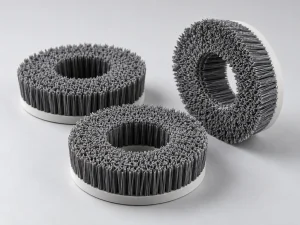
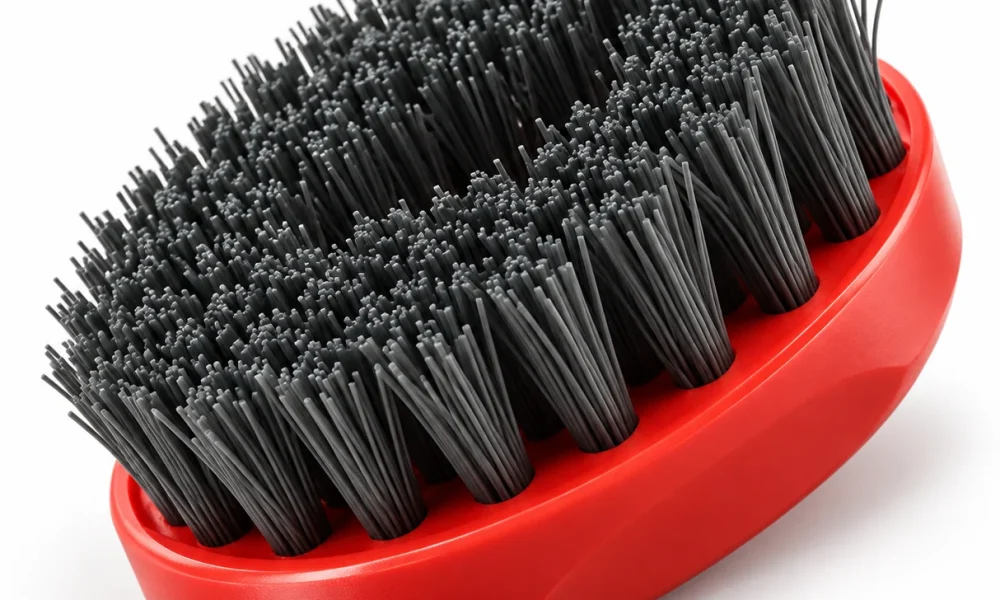
Abrasive nylon filaments contain abrasive material within the filament structure. Depending on the brush construction and application, this can allow the working surface to perform controlled cutting and finishing as contact takes place.
Such brushes can be considered for tasks including:
- Light deburring
- Edge treatment
- Surface finishing
- Cross-hole deburring
- Finishing irregular profiles
- Cleaning alongside finishing
- Repetitive treatment of similar components
The important word here is controlled.
Simply adding a powered brush to an existing production line does not automatically create a repeatable deburring process. Brush construction, filament properties, component geometry, contact and machine arrangement all influence the result.
Replacement or Process Integration?
One of the biggest mistakes when evaluating automated or semi-automated deburring is treating the decision as a choice between people and machines.
In practice, there are at least three possibilities.
Scenario A: A Strong Candidate for Brush Processing
Imagine a production line manufacturing the same component continuously.
Its dimensions remain consistent. Burrs repeatedly occur around the same edges or holes, and the required finish is clearly defined.
This is a situation worth investigating for brush-based processing.
Because the component and burr locations are predictable, manufacturers have a better opportunity to establish repeatable brush contact and operating parameters. The objective is not simply faster brushing; it is achieving a comparable result from one component to the next.
Scenario B: A Hybrid Approach Makes More Sense
Now consider a component with several predictable burr locations but one difficult internal feature.
The accessible, repeatable areas may be suitable for brushing, while the difficult feature still requires manual attention.
This creates a hybrid process.
The brush handles the work that lends itself to repeatable treatment, while an operator deals with the areas that genuinely require individual judgement.
For many manufacturers, this can be more realistic than attempting to automate every finishing task at once.
Scenario C: Manual Processing Still Has a Role
Not every operation should be converted.
Low-volume components, frequently changing geometries, unusual burr conditions or parts requiring individual inspection may still justify manual deburring.
If every component requires a different approach, creating a fixed brush process may add complexity without solving the actual problem.
The decision should therefore follow the application rather than a general assumption that automation is always preferable.
Five Questions to Ask Before Changing the Deburring Method
Before changing an established process, production and engineering teams should examine five areas.
1. Are the Component Dimensions Consistent?
Repeatable processing works best when the brush meets the component in a predictable position.
Large dimensional differences between parts can change the way filaments contact the working area. Manufacturers should therefore establish how much variation exists before deciding how the brush will be positioned.
2. Where Are the Burrs Located?
An exposed edge presents a different challenge from an internal bore or intersecting hole.
Map the burr locations before selecting equipment. Consider whether the brush must act on:
- External edges
- Flat surfaces
- Holes
- Cross holes
- Internal passages
- Irregular profiles
The location often influences brush form just as much as the burr itself.
3. What Finish Is Required?
Removing a burr is only part of the specification.
Engineering teams should also define the acceptable condition after treatment. Does the component require light edge blending? Is a particular surface appearance expected? Must dimensional characteristics remain effectively unchanged?
A clearly defined output gives the manufacturer something measurable to design the process around.
4. What Material Is Being Processed?
The workpiece material affects how the application should be approached.
Metal type, plastic, composite material, hardness and surface requirements can all influence filament and abrasive selection. The objective is to choose a combination appropriate to both the burr and the base material rather than selecting on aggressiveness alone.
5. How Will the Brush Integrate With Existing Equipment?
A brush that works correctly in isolation still has to fit the production environment.
Consider:
- Available mounting space
- Component orientation
- Rotation or movement
- Accessibility of the target area
- Wet or dry processing
- Required brush dimensions
- Replacement access
- Existing machine arrangement
Integration questions should be considered before finalising brush specifications rather than after the brush has been manufactured.
Consistency Matters More Than Simply Increasing Speed
Production teams often investigate process changes because output volume has increased. That can make cycle time an obvious concern, but speed alone is a poor measure of whether deburring has improved.
A process that works quickly but produces inconsistent edges simply moves the problem further down the line.
The better benchmark is repeatability.
When evaluating abrasive brushes for a production application, manufacturers should examine whether the chosen setup can maintain acceptable results as components continue through the process.
Several variables deserve attention.
Component geometry: The brush must reach the intended area without unwanted treatment of other features.
Brush contact: Too little contact may leave burrs behind, while inappropriate contact can affect the finish or accelerate brush wear.
Filament selection: Filament diameter, abrasive type, grit and brush construction should correspond to the required operation.
Positioning: The relative position of the component and brush needs to remain controlled.
Process repeatability: Results should be assessed across multiple components rather than judging the process from one successfully finished sample.
This turns brush selection from a purchasing decision into a manufacturing-process decision.
What an Abrasive Brush Cannot Solve by Itself
There is an important limit to any tooling change: a brush can only perform correctly when the surrounding process has been properly understood.
It cannot compensate for an application that has never been defined.
For example, poor results may continue when there is:
- Incorrect brush positioning
- Unsuitable filament or grit selection
- Excessive or insufficient contact
- Unstable component presentation
- Large variation in burr formation
- Inadequate access to the target feature
There is another possibility worth investigating as well: the burr may be a symptom of an upstream manufacturing issue.
If excessive burr formation is being caused by worn cutting tools, incorrect machining conditions or another preceding operation, changing the deburring brush addresses the result rather than the source.
Good process engineering asks both questions: How should this burr be removed, and why is this burr being produced in this condition?
Moving From Manual Work to a Repeatable Brush Process
At Ganesh Brush Manufacturers, we look at the component and its application before treating an abrasive brush as a standard catalogue choice. Factors such as the part geometry, burr location, required finish, filament characteristics and equipment arrangement can influence the brush configuration needed for the job.
Our range includes abrasive nylon brush solutions used for applications such as light deburring, surface finishing, irregular-profile finishing and cross-hole deburring. Different filament diameters, abrasive grain types and grit options can be considered according to the finishing requirement.
For manufacturers investigating whether abrasive brushes can become part of a higher-volume deburring process, the useful starting point is the application itself. Share the component details, working area and expected finish with us to discuss a brush configuration suited to the production requirement.
Frequently Asked Questions
1. When is a component a good candidate for brush-based deburring?
Components produced repeatedly with similar dimensions, predictable burr locations and a clearly defined finish are generally easier to evaluate for a brush-based process. Variable parts may require additional testing or a hybrid approach.
2. Can brush deburring completely eliminate manual finishing?
Not necessarily. Some manufacturing processes may allow most deburring to be performed by a brush, while others still require manual attention for inaccessible, irregular or application-specific areas. The decision depends on the component and burr condition.
3. Is brush deburring suitable for internal holes?
Certain brush constructions can be used for internal-hole and cross-hole deburring. However, hole diameter, burr position, accessibility, required finish and component material should be assessed before choosing the brush.
4. Should grit be selected according to how quickly material needs to be removed?
Speed should not be the only consideration. Grit selection should relate to the burr condition, component material and required finish. An unnecessarily aggressive choice may not produce the surface condition the application needs.
5. What information should be provided when requesting a custom deburring brush?
Useful information can include component material, drawings or dimensions, burr location, required finish, available machine space, brush mounting arrangement and details of whether the operation will run in wet or dry conditions.
6. How should a manufacturer test a new brush-based deburring process?
Testing should involve multiple representative components rather than a single sample. Teams should check burr removal, edge condition, surface finish, repeatability, brush contact and whether results remain acceptable across normal component variations.