
The coating failed. Not because the paint was wrong. Not because the application was rushed. The surface was not ready, and nobody caught it until the coating started peeling three months later. This is a more common story in Indian manufacturing than most quality teams would like to admit. And more often than not, abrasive brushes sit somewhere in that story, either used incorrectly, underspecified, or skipped entirely in favour of a faster but less effective preparation method.
Surface preparation is not the glamorous part of a coating or painting operation. It is also the part that determines whether everything that follows holds or fails.
What Surface Preparation Is Actually Doing
Before any coating goes on, whether it is an epoxy on structural steel, a paint on automotive components, or a protective layer on industrial equipment, the surface has to be mechanically and chemically ready to bond.
That means two things happening together:
- Removing contaminants: rust, mill scale, old coating residue, oil film, dust, and oxidation layers that prevent adhesion
- Creating surface profile: a controlled roughness that gives the coating something to grip
A smooth, clean-looking surface is not necessarily a prepared surface. In fact, surfaces that look clean to the eye are often the ones that cause the most coating failures, because the contamination is microscopic, and the profile is either too flat or inconsistent.
Abrasive brushes do both jobs when specified and used correctly. That is their practical advantage over chemical treatments and blasting in certain applications: they are controllable, repeatable, and workable in environments where blasting is not feasible.
Where Abrasive Brushes Fit In The Indian Industry Context
India’s fabrication and coating ecosystem spans heavy engineering, auto ancillary, infrastructure, consumer appliances, and export-oriented metalworking. Each has different substrate types, different coating systems, and different production constraints.
A few sectors where brush-based surface preparation is standard practice:
- Structural steel fabrication, where mill scale removal before primer application is a quality requirement, not a preference
- Auto component manufacturing, where consistent surface profile before e-coat or powder coat determines adhesion quality across high-volume production
- Agricultural and construction equipment, where the operating environment after coating is severe, and adhesion failure has real cost consequences
- Pipe and tank manufacturing, where internal and external surface preparation before anti-corrosion coating is a specification requirement in most contracts
In all of these, the surface preparation step is not optional. The question is only whether it is being done well.
The Specification Decisions That Actually Matter
Not all abrasive brushes are the same, and using the wrong type for a surface preparation application produces inconsistent results at best and surface damage at worst.
Here is what the specification decision involves:
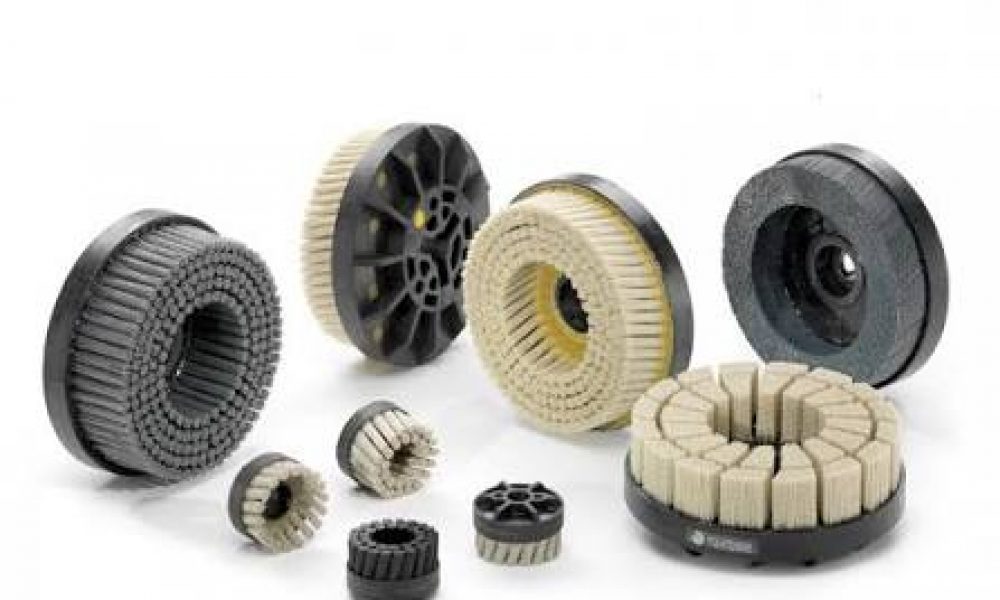
- Abrasive filament type and grit. Silicon carbide filaments are widely used for ferrous metals. Aluminium oxide variants suit harder surface applications. The grit level determines how aggressive the profile creation is, coarser grits cut faster but leave a rougher profile that may not suit all coating systems.
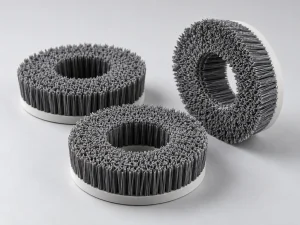
- Brush form factor. Disc brushes, wheel brushes, and cylinder brushes each suit different geometries. Flat plates take disc brushes well. Cylindrical components or pipe outer surfaces need wheel or cylindrical configurations to maintain consistent contact.
- Filament diameter and density. Thicker filaments are more aggressive and wear faster. Finer, denser fills produce more consistent surface coverage and are better suited to finishing passes before primer.
- Operating speed compatibility. Abrasive filaments are rated for specific RPM ranges. Exceeding these does not improve performance, it accelerates filament wear and creates uneven surface profiles.
Procurement teams that specify only by brush diameter and machine mount type are making an incomplete decision. The filament specification is where the actual surface preparation performance lives.
What Good Practice Looks Like On The Shop Floor
Best practice is not complicated. It is mostly about discipline and sequencing.
- Use the correct abrasive type for the substrate. Do not apply a steel-grade abrasive to aluminium components, it contaminates the surface and creates galvanic corrosion risk after coating.
- Run consistent contact pressure. Operators who press harder thinking it cleans faster are creating inconsistent surface profiles, not better ones.
- Inspect and replace brushes on schedule. Worn abrasive filaments lose their cutting geometry. A depleted brush creates friction and heat rather than surface profile.
- Do not skip the inter-pass inspection. Run a surface profile check after preparation and before primer application. The few minutes this takes catches preparation failures before they become coating failures.
- Control the time between preparation and coating. In humid Indian conditions, particularly the monsoon months, a prepared metal surface can begin to oxidise within hours. Coat promptly after preparation.
The Gap Most Operations Are Not Closing
Here is the honest version of how surface preparation works in many Indian facilities: it is the step that gets compressed when production timelines tighten. The coating schedule is fixed. The preparation step absorbs the delay.
The consequence shows up in the field, not on the shop floor. Coating failures in service get attributed to application error or material quality. The preparation step rarely gets audited after the fact.
Specifying the right abrasive brushes and enforcing a documented preparation process closes this gap. Not completely, nothing eliminates all coating failures. But surface preparation done consistently and correctly removes one of the most controllable variables in coating adhesion.
That is worth taking seriously, regardless of what sector you are in.
Closing Note
Ganesh Brush Manufacturers has been producing abrasive and industrial brushes since 2008, with manufacturing experience across metal finishing, surface treatment, and sector-specific applications. If your facility is evaluating brush specifications for surface preparation before coating, our team can work through the application requirements with you.
Not sure which abrasive filament type suits your substrate? Our team helps fabricators and coating lines get the specification right the first time.
FAQs
1. Why are abrasive brushes important for surface preparation before coating and painting?
Abrasive brushes help remove contaminants such as rust, oxidation, old coatings, and surface debris while creating the surface profile needed for proper coating adhesion. Effective surface preparation reduces the risk of premature coating failure and improves long-term durability.
2. What types of abrasive brushes are commonly used for surface preparation?
Disc brushes, wheel brushes, and cylindrical brushes are commonly used depending on the component shape and application. The choice depends on factors such as substrate material, surface geometry, coating requirements, and production processes.
3. How do I choose the right abrasive filament for my application?
The ideal abrasive filament depends on the substrate and desired surface finish. Silicon carbide and aluminium oxide are popular options, with different grit sizes available to achieve varying levels of material removal and surface roughness.
4. Can worn abrasive brushes affect coating performance?
Yes. Worn brushes lose their cutting efficiency and may fail to create a consistent surface profile. This can result in poor coating adhesion, uneven finishes, and increased risk of coating failure over time.
5. How soon should a surface be coated after abrasive brush preparation?
Prepared surfaces should be coated as soon as possible, especially in humid environments. Delaying coating application can allow oxidation, moisture, or contaminants to settle on the surface, potentially affecting coating adhesion and performance.