
A conveyor cleaning brush does a simple job, but when it starts wearing out, the effects can spread across the production line. Residue may remain on the belt, debris can collect around rollers, and operators may need to stop the conveyor for additional cleaning. Maintenance teams do not always need to replace a brush after a fixed number of days or months. Its condition and cleaning performance are better indicators. In this guide, we look at eight signs that a conveyor brush is due for replacement, along with the checks that can help prevent premature wear.
1. The Bristles Are Visibly Worn Or Flattened
Some wear is expected. Industrial brushes are working components, after all.
The problem starts when the bristles have become noticeably flattened, shortened or permanently bent. Once the filaments lose their original shape, they may no longer make the contact needed to remove material from the conveyor.
A worn brush can still look usable at first glance. Check it against a new section of the brush if possible. The difference in bristle height and flexibility can be surprisingly obvious.
2. Cleaning Quality Has Started To Drop
This is probably the clearest warning sign.
If the conveyor used to come away clean but now leaves behind dust, product residue, chips or other debris, inspect the brush before assuming there is a problem with the conveyor itself.
Poor cleaning can happen when:
- Bristles have become too short
- Filaments have lost their stiffness
- The brush has developed uneven wear
- The brush is no longer making sufficient contact
- Material has become trapped between the bristles
If cleaning performance continues to decline after basic adjustments, replacement may be the sensible next step.
3. The Brush Is Wearing Unevenly
A brush that is worn more heavily at one end than the other deserves closer attention.
Uneven wear can mean that the brush is not sitting correctly against the conveyor. Alignment, mounting or contact pressure may need to be checked before ordering a replacement.
| What you see | What it may indicate |
| Even wear across the brush | Normal service wear |
| Heavy wear at one end | Alignment or pressure issue |
| Flattened section in the middle | Excessive contact |
| Missing or damaged filaments | Mechanical damage or unsuitable brush material |
| Residue collecting in one area | Inconsistent cleaning contact |
Replacing the brush without checking the reason for uneven wear can lead to the same problem with the next one.
4. Operators Are Adjusting The Brush More Often
A conveyor brush should not need constant intervention to do its job.
If maintenance staff are repeatedly changing its position, increasing pressure or making small adjustments just to achieve acceptable cleaning, the brush may have reached the end of its useful working life.
There is another possibility, too. The original brush specification may not be quite right for the application.
If the same adjustment problem has occurred with several replacement brushes, it is worth reviewing the brush design rather than simply installing another identical one.
5. The Conveyor Surface Is No Longer Being Cleaned Evenly
Look at the entire width of the conveyor.
If one side is clean while the other still has residue, the brush may not be contacting the belt consistently. This can happen because of bristle wear, incorrect positioning or a change in the brush’s shape.
For wider conveyor systems, this is particularly important. A small difference in brush height or pressure can become much more noticeable across the full working width.
The brush should provide consistent cleaning without excessive pressure on the conveyor surface.
6. Bristles Are Breaking, Shedding Or Becoming Damaged
Broken filaments are more than a sign of an old brush.
The cause needs to be investigated.
Abrasive materials, excessive pressure, high temperatures, chemicals or an unsuitable filament can all shorten brush life. In some production environments, loose bristles may also create a product contamination concern.
If the brush is shedding filaments regularly, do not simply treat it as normal wear. Check whether the brush material and construction are appropriate for the operating conditions.
7. The Brush Is Causing More Friction Than Before
A change in machine behaviour can sometimes point towards brush wear or incorrect positioning.
If the conveyor requires noticeably more effort to run, or the brush creates increased resistance and heat, inspect the contact between the brush and conveyor.
Too much pressure can flatten the bristles against the belt. This increases friction without necessarily improving cleaning.
The correct setup should provide enough contact to remove debris while allowing the filaments to flex naturally.
8. The Brush Has Exceeded Its Practical Service Life
There is no universal replacement schedule for every conveyor cleaning brush.
Two brushes used on different production lines may experience completely different levels of wear. Conveyor speed, operating hours, material being removed, moisture, chemicals, temperature and brush pressure all affect service life.
Instead of relying only on a calendar, maintenance teams can track:
- Installation date
- Operating hours
- Cleaning performance
- Visible bristle wear
- Replacement frequency
- Any changes in conveyor performance
This gives a much clearer picture of how long the brush actually lasts in that particular application.
Should You Replace The Brush Or Adjust It?
Not every cleaning problem means the brush needs replacing.
Before removing it, check the basic setup.
Inspect the brush
Look for flattened, broken or heavily worn filaments.
Check alignment
Make sure the brush is sitting correctly across the conveyor and has not shifted from its original position.
Check contact pressure
Too much pressure can accelerate wear. Too little can leave debris behind.
Check the conveyor
Damage, belt deformation or changes in belt tracking can affect brush contact.
Check the operating environment
If the brush is exposed to more moisture, chemicals, heat or abrasive material than expected, the existing specification may no longer be suitable.
If the brush is physically worn and cleaning performance has declined, adjustment is unlikely to provide a lasting solution.
What Happens If You Keep Using A Worn Conveyor Brush?
It can be tempting to get a few more weeks out of a brush that “still works”.
That decision can become expensive if cleaning quality continues to fall.
A worn brush may leave residue on the conveyor, increase manual cleaning requirements and place additional demands on other parts of the production process. In applications where cleanliness is closely tied to product quality, the consequences can be more serious.
There is also the issue of predictable maintenance. A brush that is already heavily worn is more likely to fail unexpectedly than one replaced based on its actual condition.
Planned replacement is generally easier to manage than an unplanned stoppage.
Choosing The Right Replacement Brush
Replacing a worn brush with exactly the same specification is not always the right answer.
If the previous brush wore out unusually quickly, ask why.
Consider these points before ordering:
- Conveyor surface: Is it rubber, metal, plastic or another material?
- Material being removed: Dust, powder, chips, food residue and sticky material require different brushing actions.
- Conveyor speed: Higher speeds can change the required brush configuration.
- Operating hours: A brush running continuously faces greater wear than one used intermittently.
- Filament type: Nylon, polypropylene, abrasive filaments, natural fibres and wire each behave differently.
- Brush dimensions: Diameter, width and bristle length need to suit the available space.
- Environment: Moisture, chemicals and temperature can affect filament performance.
Sometimes the problem is simply that the brush has reached the end of its service life. In other cases, repeated wear points towards a need for a different brush design.
When A Custom Conveyor Cleaning Brush Is Worth Considering
Standard brushes are suitable for many conveyor systems. But if the equipment has unusual dimensions or the cleaning requirement is particularly specific, a custom brush may be more appropriate.
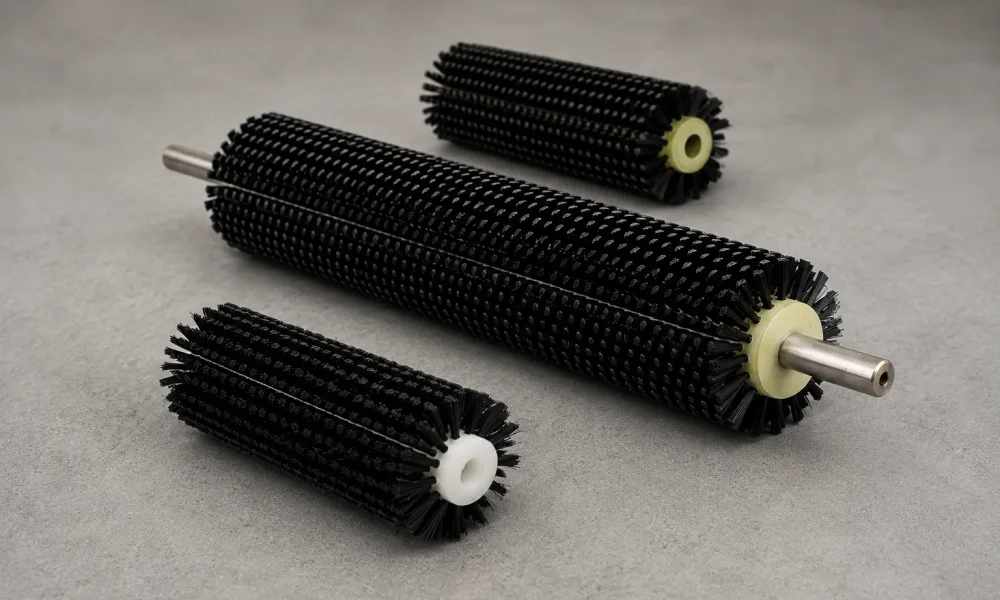
Ganesh Brush Manufacturers produces industrial brush solutions for conveyor and machinery cleaning applications, including cylindrical brush rollers and customised brush configurations.
A custom brush can be specified around the actual conveyor rather than relying on a standard size. Depending on the application, factors such as brush dimensions, filament material, bristle length and density can be considered.
This can be useful when a standard brush repeatedly wears unevenly, leaves unclean areas or simply does not fit the equipment properly.
A Simple Maintenance Rule
The easiest way to manage conveyor brush replacement is to stop treating it as a purely time-based task.
Watch what the brush is doing.
If cleaning performance has dropped, the bristles are heavily worn, wear is uneven or the brush is causing excessive friction, investigate it. If basic adjustments do not solve the issue, replacement is probably due.
And if the same problems keep returning with every replacement, it may be time to review the brush specification itself.
At Ganesh Brush Manufacturers, we help businesses select industrial brushes according to the actual cleaning application, conveyor setup and operating conditions. Our team can advise on suitable brush configurations, including customised options where a standard conveyor cleaning brush does not provide the required fit or performance.
Frequently Asked Questions
1. How often should a conveyor cleaning brush be replaced?
There is no fixed replacement period. Brush condition, cleaning performance, operating hours and wear are better indicators than calendar time alone.
2. What is the main sign that a conveyor brush needs replacing?
A noticeable drop in cleaning performance, combined with worn, flattened or damaged bristles, usually indicates that the brush needs attention.
3. Can a worn brush damage a conveyor belt?
Yes. Excessive pressure, damaged filaments or an unsuitable brush can increase friction and potentially affect the conveyor surface.
4. Why does my conveyor brush wear unevenly?
Uneven wear can result from incorrect alignment, inconsistent contact pressure, belt tracking issues or an unsuitable brush configuration.
4. Can I use the same brush for every conveyor?
Not necessarily. Conveyor material, speed, debris type, operating environment and available space all affect brush selection.
6. Can conveyor cleaning brushes be customised?
Yes. Brush dimensions, filament material, bristle length and other specifications can be adapted for specific conveyor applications.
7. How can I make a conveyor brush last longer?
Use the correct filament and brush configuration, maintain suitable contact pressure, check alignment regularly and inspect the brush for early signs of uneven wear or damage.