
Sealing and cleaning are often treated as similar applications, but in practice, they demand very different brush behaviour. One requires the brush to maintain position and block movement. The other requires active surface contact to remove debris, dust, or contaminants.
Choosing flexible strip brushes for either application starts with understanding what the brush is actually expected to do. The specification changes significantly depending on the primary function, and that difference directly affects brush life, sealing efficiency, cleaning performance, and surface safety.
When selection goes wrong, the result is usually predictable. The brush wears prematurely, fails to maintain sealing pressure, or damages the surface it was supposed to protect. In most cases, the problem begins much earlier during the specification itself. The brush was selected based on channel size or previous purchase history instead of the actual operating conditions.
First Question: Is The Brush Sealing Or Cleaning?
This sounds straightforward, but many industrial applications involve elements of both.
Many applications involve both. A brush at the entry of a conveyor enclosure might need to keep dust out (sealing) while also wiping debris off the product surface as it passes (cleaning). These are conflicting demands, and treating them as one job guarantees compromise.
If the primary function is sealing, the brush needs consistent contact pressure over time without significant deflection. Bristle recovery matters more than bristle aggression. The filament needs to return to its original position thousands of times without taking a permanent set.
If the primary function is cleaning, the brush needs to actively engage with the surface. Bristle stiffness, tip speed, and contact angle determine whether the brush actually removes the debris or just pushes it around.
The honest answer for dual-function positions is often two separate brushes. Trying to find a single flexible strip brushes configuration that does both well usually means it does neither well enough.
Second Question: Where Are The Bristles In Contact?
This determines filament material.
- Polished or painted metal surfaces. Soft filaments only. Nylon or polypropylene. Anything stiffer will leave marks under inspection lighting.
- Raw steel, castings, or rough surfaces. Steel wire or abrasive nylon. The surface can take aggression.
- Food contact surfaces. FDA-compliant filaments, typically nylon 6.12 or polyester. No shedding. No contamination risk.
- Rubber, plastic, or coated surfaces. Medium-stiffness nylon. Stiff enough to clean, soft enough not to abrade the coating.
- Glass or optical surfaces. Natural hair or very fine synthetic filaments. Zero tolerance for scratching.
The mistake buyers make is specifying filament material based on what they used last time, without checking whether the surface condition has changed. A line that switched from raw steel to powder-coated steel six months ago still has brushes spec’d for raw steel. Nobody updated the order. The scratches on the new coating are evidence.
Third Question: Which Environment Is Brush Working In?
Temperature, moisture, and chemical exposure each eliminate options.
Standard polypropylene softens above 80°C. Nylon absorbs moisture and loses stiffness in wet environments. Steel wire corrodes in acidic or humid conditions unless you specify stainless. These are not edge cases. A textile dyeing unit runs hot and wet. A pharmaceutical cleanroom runs cold and dry. A rolling mill runs hot and oily.
If you do not specify the environment when ordering, the manufacturer cannot select the right filament. And most buyers do not specify it, because the purchase requisition form has fields for length, width, and quantity. Not for operating temperature or chemical exposure.
That gap between what the form asks and what the application needs is where most selection failures start.
Fourth Question: What Does Mounting Look Like?
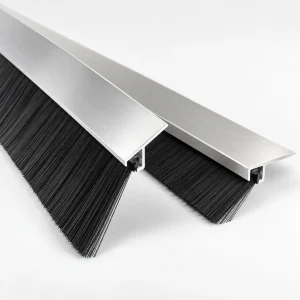
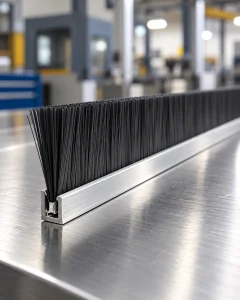
Strip brushes mount into aluminium or steel channels, screw directly to surfaces, or clip into proprietary holders. Two things to get right:
- Trim length (bristle length past the channel) controls how much deflection the brush absorbs. Too short and it cannot track an uneven surface. Too long and the bristles lack stiffness to exert useful pressure.
- Strip profile (the metal backing holding the filaments) must match the channel precisely. A loose fit causes vibration and accelerated wear. A tight fit makes field replacement unnecessarily difficult.
Measure the channel. Do not estimate it.
Selection Is The Specification
Every question above narrows the specs. By the time you have answered all four, you have defined filament material, filament diameter, trim length, strip profile, and mounting method. That is not a catalogue browse. That is an engineering conversation.
The manufacturers worth working with will walk you through this before they quote. The ones who skip it will send you a price and a delivery date. Both ship a brush. Only one ships the right one.
Conclusion
Most flexible strip brush failures are not caused by poor manufacturing. They happen because the application was oversimplified during selection. A brush meant for sealing was expected to clean. A filament chosen for raw steel was later used on coated surfaces. An environment with heat, moisture, or chemicals was never discussed during specification. Over time, those small mismatches become visible through faster wear, inconsistent sealing, surface damage, or declining cleaning performance.
That is why flexible strip brushes work best when selection is treated as an engineering decision rather than a catalogue purchase. The right combination of filament material, trim length, strip profile, and mounting design depends entirely on how the brush behaves inside the actual operating environment.
At Ganesh Brush Manufacturers, the focus is on understanding those operating conditions first and then developing flexible strip brush solutions that balance durability, contact performance, and long-term application reliability across industrial sealing and cleaning systems.
FAQs
- How do you choose flexible strip brushes for industrial applications?
Choose flexible strip brushes based on the primary function, contact surface, working environment, filament material, trim length, strip profile, and mounting method.
- What is the difference between strip brushes for sealing and cleaning?
Sealing brushes need consistent contact pressure and bristle recovery, while cleaning brushes need the right stiffness, contact angle, and surface engagement to remove debris.
- Which filament material is best for flexible strip brushes?
The best filament material depends on the surface. Nylon or polypropylene works for polished surfaces, steel wire suits rough metal, FDA-compliant nylon or polyester suits food contact, and fine synthetic or natural hair suits glass.
- Why does the working environment matter when selecting strip brushes?
Temperature, moisture, oil, and chemical exposure affect filament performance. The wrong material can soften, corrode, lose stiffness, or wear out faster.
- What mounting details should buyers check before ordering strip brushes?
Buyers should check the channel size, strip profile, trim length, fit tolerance, and replacement method to avoid vibration, poor sealing, fast wear, or difficult installation.